Why Cognitive Load Matters in Orthopedic Surgery Planning
Orthopedic surgery requires continuous spatial reasoning, anatomical interpretation, and procedural decision-making under strict time constraints. Surgeons must simultaneously evaluate imaging, manage instrumentation, interpret tactile feedback, and adapt to intraoperative findings. Within this environment, the concept of cognitive load becomes highly relevant.
Cognitive load refers to the amount of mental effort required to perform a task. In surgical environments, excessive cognitive load can increase decision density, reduce workflow stability, and potentially influence performance consistency. While variability in anatomy is inevitable, variability introduced by unstructured decision-making can often be reduced through structured preparation.
In orthopedic surgery, many of the decisions that influence intraoperative complexity are defined well before the first incision. Preoperative planning, therefore, represents a critical stage where analytical workload can be transferred from the operating room to a controlled environment. By structuring surgical intent in advance, surgeons reduce the number of decisions that must be made under intraoperative pressure.
Understanding the relationship between cognitive load and surgical preparation helps clarify why structured planning has become increasingly important in contemporary orthopedic workflows.
Decision Density in the Operating Room
Orthopedic procedures involve numerous interconnected decisions. Implant sizing, alignment targets, resection levels, and rotational positioning all require evaluation. When these decisions occur simultaneously during surgery, the number of active considerations increases substantially.
Human factors research demonstrates that performance stability can be influenced by the number of decisions required in a given time frame. As cognitive demands increase, attention becomes divided between multiple tasks. In surgical settings, this can translate into increased procedural variability.
Reducing decision density does not eliminate surgical judgment. Instead, it shifts analytical processes to an earlier phase. When alignment philosophy, implant selection, and anatomical targets are established before surgery, intraoperative execution becomes more focused and predictable.
Preoperative planning effectively redistributes cognitive effort from the operating room to the preparation stage.
Preoperative Planning as Cognitive Offloading
One of the most significant advantages of structured planning is cognitive offloading. Cognitive offloading occurs when complex mental tasks are transferred to external systems or preparatory processes.
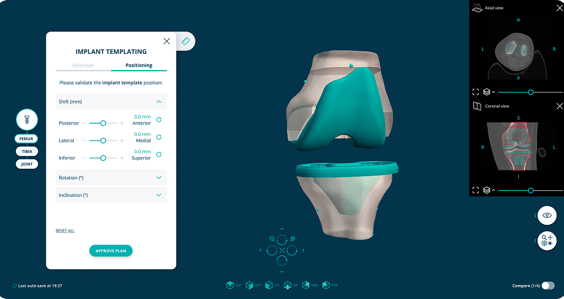
In orthopedic surgery, digital planning tools allow surgeons to analyze imaging, template implants, and evaluate anatomical alignment before the procedure begins. This enables surgeons to visualize surgical scenarios and anticipate challenges.
By establishing a defined surgical strategy in advance, surgeons enter the operating room with a structured framework for execution. Instead of evaluating multiple variables simultaneously, they can focus on implementing a pre-defined plan and making targeted adjustments when necessary.
This approach does not reduce surgical autonomy. Rather, it provides a stable reference point for intraoperative decision-making.
Workflow Stability and Surgical Consistency
Stable surgical workflows depend on predictability. When key procedural parameters are defined in advance, intraoperative steps become more consistent.
Planning influences several aspects of surgical workflow, including:
- implant sizing expectations
- alignment targets
- anticipated bone resections
- instrumentation requirements
When these elements are clarified preoperatively, teams can prepare more effectively. Instrument trays, implant options, and procedural sequencing become aligned with the intended surgical strategy.
Consistency at the planning stage, therefore, contributes to workflow stability during execution.
In high-volume orthopedic centers, this stability becomes particularly valuable. Standardized preparation processes support reproducibility across cases and across surgeons.
The Human Factors Perspective in Surgery
Human factors research has increasingly influenced the design of complex operational environments, including aviation, nuclear engineering, and healthcare. In these fields, workflow design aims to reduce unnecessary cognitive burden while preserving decision authority.
Orthopedic surgery shares similar characteristics. Procedures require precision, situational awareness, and the ability to adapt to unexpected findings. However, many analytical decisions can be structured before surgery begins.
Reducing cognitive load through preparation does not eliminate complexity. Instead, it organizes complexity in a way that supports consistent performance.
As digital planning technologies evolve, they increasingly function as decision-support frameworks rather than simple visualization tools. Their role is to structure information, quantify anatomical parameters, and support the surgeon's analytical process before entering the operating room.
Conclusion
Cognitive load is an inherent component of surgical practice. However, the distribution of that cognitive effort across the surgical workflow can be optimized.
When preoperative planning is structured and analytical decisions are defined in advance, surgeons reduce intraoperative decision density and improve workflow stability. This supports more consistent execution and clearer alignment between surgical intent and surgical outcome.
Precision in orthopedic surgery is not only a matter of technical skill. It is also a matter of preparation.
References
Weigl M et al. BMJ Quality & Safety. 2017.
Catchpole K et al. Annals of Surgery. 2008.
Arora S et al. Annals of Surgery. 2010.
Helmreich RL. Human Factors in Aviation Safety. 2000