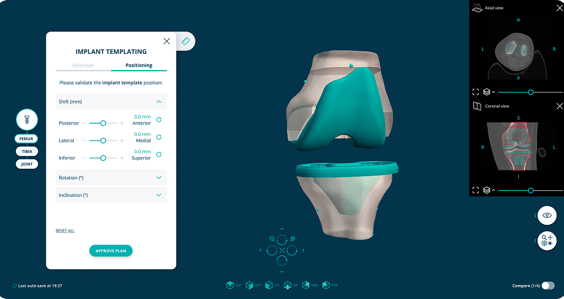
How Planning Improves Implant Positioning
Implant positioning accuracy is one of the most decisive determinants of outcome in contemporary orthopedic surgery. In total joint arthroplasty, component orientation influences joint kinematics, load distribution, polyethylene wear patterns, ligament balance, and long-term implant survivorship. While intraoperative execution often receives the greatest attention, the structural determinants of positioning precision are defined earlier, during preoperative planning.
Preoperative planning accuracy in orthopedic surgery represents the analytical phase in which surgical intent is quantified, measured, and biomechanically justified. This stage establishes the framework within which intraoperative decisions occur. When structured appropriately, it reduces variability, improves reproducibility, and enhances confidence in final implant positioning.
The Biomechanical Impact of Implant Positioning
The relationship between alignment and outcome has been extensively studied. In total knee arthroplasty (TKA), early literature emphasized restoration of a neutral mechanical axis within ±3 degrees, associating malalignment with increased risk of loosening and revision (Jeffery et al., 1991). Although long-term studies have nuanced this threshold (Parratte et al., 2010), alignment remains biomechanically relevant.
Femoral component rotation influences patellofemoral tracking and flexion gap balance. Tibial slope affects posterior cruciate ligament tension and flexion kinematics. In total hip arthroplasty (THA), acetabular inclination and anteversion influence joint stability, impingement risk, and wear patterns.
These variables illustrate a fundamental principle: implant positioning is not an isolated technical step. It is a biomechanical determinant.
Precision, therefore, cannot rely solely on intraoperative visual estimation.
Preoperative Planning as a Determinant of Surgical Accuracy
Preoperative planning accuracy in orthopedic surgery allows surgeons to define:
- Alignment strategy (mechanical, kinematic, restricted kinematic)
- Implant sizing and templating
- Anticipated bone resections
- Restoration of the joint line and offset
- Management of deformity
When these decisions are structured before surgery, intraoperative execution becomes more controlled.
Without systematic planning, surgeons may encounter unexpected sizing discrepancies, rotational adjustments, or alignment reconsiderations during the procedure. While adaptability is essential, repeated intraoperative corrections increase variability and cognitive demand.
Digital planning environments shift part of the analytical burden away from the operating room. Calibrated imaging and templating tools enable simulation of implant positioning relative to anatomical landmarks. This structured preparation supports deliberate execution rather than reactive adjustment.
Reducing Alignment Outliers Through Structured Workflows
Technology-assisted workflows have demonstrated reductions in alignment outliers compared with conventional instrumentation (Bauwens et al., 2007; Hetaimish et al., 2012). While outcomes depend on multiple factors, one consistent finding emerges: pre-defined alignment parameters improve consistency.
Alignment outliers are not merely statistical deviations. They represent departures from surgical intent. When planning is clearly documented, deviations can be evaluated relative to a defined objective rather than retrospectively interpreted.
This distinction is particularly relevant in high-volume arthroplasty centers where reproducibility across cases is critical.
Cognitive Load and Decision Stability
Orthopedic surgery demands simultaneous management of spatial orientation, soft tissue balance, instrumentation, and time constraints. Human factors research demonstrates that increased cognitive load can influence performance stability (Weigl et al., 2017).
By transferring alignment analysis and implant selection to the preoperative phase, surgeons reduce intraoperative decision density. This supports consistency and may reduce workflow interruptions.
Structured preparation does not eliminate intraoperative judgment. It anchors it.
The Growing Importance of Individualized Alignment
Modern alignment philosophies increasingly recognize constitutional limb alignment and patient-specific kinematics. However, individualized strategies require more, not less, analytical rigor.
Preoperative evaluation of deformity magnitude, joint line orientation, and soft tissue envelope must be deliberate. Without structured planning, personalization risks inconsistency.
Preoperative planning accuracy in orthopedic surgery enables surgeons to reconcile individualized alignment targets with reproducible execution.
Implant positioning accuracy is not achieved at the moment of fixation. It is defined during preparation.
When alignment objectives, implant sizing, and biomechanical considerations are established preoperatively, intraoperative variability decreases and reproducibility increases.
Precision in orthopedic surgery is prepared, not improvised.
References
- Jeffery RS et al. J Bone Joint Surg Br. 1991.
- Parratte S et al. Clin Orthop Relat Res. 2010.
- Bauwens K et al. J Bone Joint Surg Am. 2007.
- Hetaimish BM et al. J Arthroplasty. 2012.
- Weigl M et al. BMJ Qual Saf. 2017.