Improving OR Efficiency Through Preoperative Planning
Time inside the operating room is one of the most constrained and valuable resources in healthcare. Every minute carries clinical, operational, and financial implications. In orthopedic surgery, where procedures involve multiple steps, instruments, and decision points, even small inefficiencies can accumulate quickly.
While efforts to improve efficiency often focus on intraoperative tools or surgical technique, a significant portion of operating room performance is shaped earlier, during preoperative planning.
The way a procedure is prepared influences how smoothly it unfolds.
Where Time Is Lost in the Operating Room
Operating room delays are rarely caused by a single major issue. More often, they result from a series of small interruptions that disrupt workflow continuity.
Implant sizing may need to be reassessed. Alignment targets may be reconsidered. Additional instruments may be requested. These adjustments are part of surgical reality, but when they occur repeatedly, they extend procedure time and increase workflow complexity.
Many of these moments share a common origin: decisions that were not fully defined before the procedure began.
When planning is incomplete or unstructured, analytical work shifts into the operating room, where time pressure is highest.
Preoperative Planning as a Workflow Strategy
Preoperative planning is often viewed as a clinical step. It is equally a workflow strategy.
By defining implant positioning, alignment approach, and surgical sequence in advance, planning reduces the number of decisions that need to be made during the procedure. This allows the surgical team to operate within a clearer framework.
When surgical intent is well defined, communication improves. Instrument preparation becomes more precise. The procedure progresses with fewer interruptions.
This does not eliminate intraoperative decision-making. It reduces the need for reactive adjustments.
Reducing Procedural Variability
Efficiency and consistency are closely linked.
Procedures that follow a structured plan tend to progress more predictably. When key parameters are established in advance, the likelihood of unexpected adjustments decreases.
This has implications beyond time alone. More consistent workflows support better coordination between surgeons, nurses, and operating room staff. They also make it easier to anticipate procedural needs across cases.
In high-volume environments, this level of predictability becomes essential.
The Economic Impact of Surgical Time
Operating room time is directly tied to hospital costs. Extended procedures affect scheduling, staffing, and resource allocation.
Even incremental reductions in procedure duration can have a meaningful impact when scaled across multiple cases.
From a hospital perspective, improving efficiency is not simply about speed. It is about reducing variability, minimizing disruptions, and optimizing how resources are used.
Preoperative planning contributes to this by shifting analytical work away from the operating room and into a more controlled environment.
The Role of Digital Planning Tools
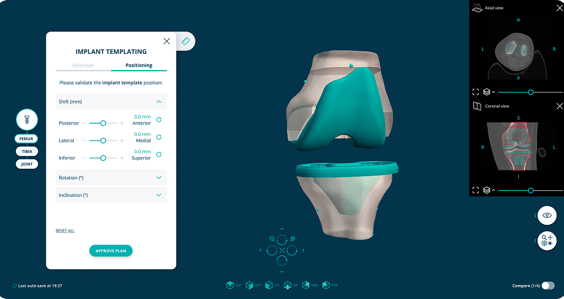
Digital planning environments provide surgeons with tools to analyze imaging, template implants, and define procedural strategy before entering the operating room.
These systems allow teams to prepare with greater clarity. Implant options can be evaluated in advance. Alignment strategies can be reviewed. Potential challenges can be anticipated.
This preparation supports a smoother intraoperative workflow.
Importantly, digital planning does not replace clinical judgment. It supports it by structuring the information surgeons rely on when making decisions.
Improving operating room efficiency does not begin when the procedure starts. It begins during preparation.
When surgical intent is clearly defined before the first incision, procedures tend to progress with fewer interruptions, more predictable workflows, and greater coordination across the surgical team.
In orthopedic surgery, efficiency is not simply a function of speed. It is the result of structured decision-making.
Preoperative planning plays a central role in making that possible.
References
Childers CP, Maggard-Gibbons M. JAMA Surgery. 2018.
Weigl M et al. BMJ Quality & Safety. 2017.
Zywiel MG et al. Journal of Bone and Joint Surgery. 2011.