Why FDA Clearance Is Critical for AI in Orthopedic Surgery
FDA clearance is critical for AI in orthopedic surgery because it ensures that software used in clinical planning meets US safety, performance, and regulatory standards before it influences patient care.
What FDA Clearance Means for AI Medical Software (H2)
FDA clearance is often misunderstood.
It does not mean that software is perfect or that it replaces clinical expertise. It means something more practical and more important.
For AI used in orthopedic surgical planning, FDA clearance confirms that the system performs as intended, within defined limits, and under controlled risk. Most orthopedic planning tools follow the FDA 510(k) pathway, which requires manufacturers to demonstrate that their software is substantially equivalent to a legally marketed medical device.
In practice, this process forces clarity. The intended use must be clearly defined. The clinical role of the software must be explicit. And known risks must be identified and mitigated before the tool is introduced into real workflows.
For surgeons and hospitals, this creates a baseline of trust.
Why Orthopedic AI Cannot Be Treated Like Regular Software
Orthopedic surgical planning is not a generic digital task.
It directly influences decisions about implants, alignment, sizing, and surgical approach.
When AI enters this stage, it becomes part of the clinical decision-making chain. That alone justifies regulatory oversight.
Without FDA review, there is no formal validation that an AI system behaves consistently across different anatomies, imaging inputs, or edge cases. There is also no external verification that outputs remain stable over time or that updates do not introduce new risks.
In orthopedic surgery, small deviations can matter. Regulation exists to reduce uncertainty where the margin for error is already tight.
How FDA Clearance Supports Surgeons, Not Automation
One of the biggest concerns around AI in surgery is loss of control.
FDA-cleared AI tools are designed to avoid that.
These systems are built to support surgeons by standardizing repetitive planning steps, reducing variability, and presenting structured insights. They do not make final decisions. They do not operate independently.
Instead, they act as clinical decision support tools. Surgeons remain fully responsible for reviewing, adjusting, and approving every plan.
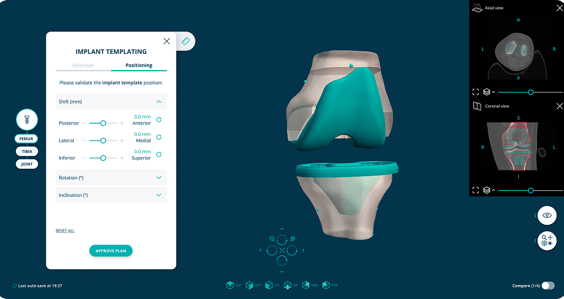
This balance is intentional. It allows AI to improve consistency without undermining professional judgment. PeekMed follows this model by combining automation with full surgeon oversight throughout the planning process.
Why FDA Clearance Matters to US Hospitals and Health Systems (H2)
In the US, hospitals operate within complex compliance frameworks.
Any software that influences clinical care must pass internal reviews covering safety, IT security, procurement, and legal responsibility.
FDA clearance simplifies this process. It signals that the software has already undergone regulatory scrutiny and aligns with national standards for medical devices.
Without clearance, adoption becomes difficult. Even if a tool appears useful, it may never pass institutional approval. From a hospital perspective, FDA clearance is not a differentiator. It is often the minimum requirement to even start a conversation.
FDA Clearance as the Foundation of Trust
AI will continue to shape orthopedic surgery, especially in the operating room.
But innovation without regulation creates uncertainty.
FDA clearance provides structure. It defines how AI can be used safely, how risks are managed, and how responsibility is shared between software and the surgeon.
For orthopedic teams in the US, FDA-cleared AI is not about speed or novelty. It is about trust, consistency, and patient safety.
That is why FDA clearance remains a critical foundation for AI-driven surgical planning.
References
-
U.S. Food & Drug Administration — Software as a Medical Device (SaMD)
-
FDA — 510(k) Premarket Notification
-
American Academy of Orthopaedic Surgeons (AAOS)