Why Predictability Is Orthopedic Surgery’s Most Important Metric
If you operate regularly, you’ve already seen this: two procedures scheduled back-to-back. Similar patients, comparable anatomy, same surgical plan. And yet, once you begin, the cases don’t unfold the same way.
One moves with clarity. Landmarks are straightforward, decisions feel almost anticipated. The other requires more adjustment; alignment takes longer, decisions happen in real time, and the overall flow shifts. Nothing goes wrong. But the experience, and often the outcome, is not identical. That difference is variability. And for a long time, it has been accepted as part of surgery.
The problem is not variability itself. It’s what it creates at scale. In a single case, small intraoperative differences rarely raise concern. A few extra minutes here, a slight adjustment there, these are part of everyday surgical practice. But, across multiple cases, those variations begin to accumulate.
Procedures that should follow a similar timeline start to diverge. Team coordination becomes less predictable. Post-operative pathways vary more than expected. Individually, these changes are subtle. At scale, they define how a system performs.
This is why consistency is becoming a priority
Healthcare systems in the U.S., influenced by models from the Centers for Medicare & Medicaid Services, are placing increasing emphasis on consistency, not just outcomes. Because consistency enables reliable OR scheduling, better resource allocation, and more predictable patient flow.
In this context, success is no longer measured by isolated results. It’s measured by how reproducible those results are.
So where does variability actually come from?
Not from a lack of skill. In many cases, it comes from when decisions are made.
When key choices - alignment strategy, implant positioning, intraoperative adjustments - happen under time pressure, they are influenced by uncertainty. Even experienced surgeons adapt differently depending on what they encounter in the moment.
That variation is natural. But it’s also avoidable, at least in part.
What changes when decisions move upstream
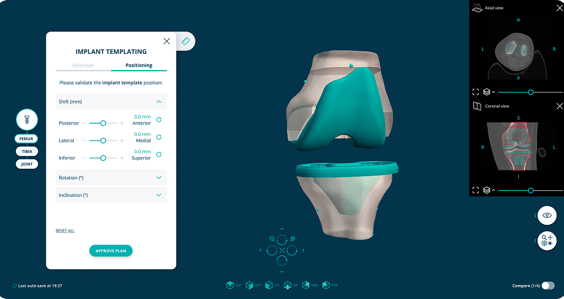
When a case is approached with structured preoperative planning, the starting point is different. Instead of entering the OR to determine the strategy, you enter with a defined approach. Critical decisions have already been explored in a lower-pressure setting, where time and clarity are not competing factors.
Intraoperative judgment remains essential. But it becomes more focused, used to validate and refine, rather than to define from scratch. And that shift reduces variability where it matters most.
The impact goes beyond the procedure itself
As variability decreases, the effects extend across the system. Surgical timelines become more consistent, making scheduling more reliable. Teams begin to anticipate each step more accurately, improving coordination in the OR. Even recovery pathways tend to stabilize when intraoperative decisions are more consistent.
In other words, predictability improves not only how surgery is performed, but how it integrates into the broader hospital workflow.
Experience still matters, but it doesn’t scale on its own. Surgical expertise remains critical. Experience allows for better judgment, faster adaptation, and stronger outcomes. But, from a system perspective, experience alone is difficult to standardize.
Different surgeons approach similar cases differently. Without a shared structure before surgery begins, variability between approaches becomes inevitable. Preoperative planning helps bridge that gap, creating alignment without removing autonomy.
The shift is subtle, but significant. This isn’t about making surgery rigid or removing flexibility. It’s about being more intentional with decision-making. Moving key choices earlier in the process reduces unnecessary variability while preserving the ability to adapt when needed. And over time, that balance is what enables consistency.
Surgery will always involve adaptation. But relying on adaptation for every critical decision is no longer the most effective model. As expectations around consistency continue to grow, predictability is becoming a defining characteristic of high-performing orthopedic systems.
REFERENCES
1. Centers for Medicare & Medicaid Services. Value-Based Programs. Baltimore, MD: CMS; 2023.
2. American Academy of Orthopaedic Surgeons. Clinical Practice Guidelines. Rosemont, IL: AAOS; 2022.
4. Porter ME. What is value in health care? N Engl J Med. 2010;363(26):2477–2481.
5. Bozic KJ et al. Bundled payments in total joint arthroplasty. Clin Orthop Relat Res. 2014;472(1):188–193.