How Preoperative Planning Fits Into Real Surgical Workflows
The day doesn’t start in the operating room. Your first case is scheduled for 8:00 AM. By the time you step into the hospital, you already have a mental map of the day: cases lined up, varying complexity, limited time between procedures. There’s a rhythm you’ve built over years of practice. It’s efficient, but it’s also tight.
You review imaging quickly. You recall the patient. You confirm your approach. And then you move on. Because you have to. Now here’s the part that’s easy to overlook: most of the critical decisions for that surgery haven’t actually been fully explored yet.
They’ve been outlined. Estimated. Anticipated. But not deeply tested.
Planning exists. But it often lives under time pressure. No surgeon walks into the OR unprepared. You’ve already thought about alignment. You’ve considered implant sizing. You’ve anticipated possible constraints.
But in many cases, that planning happens:
- between consultations
- between cases
- or at the end of a long day
Which means something subtle happens. Planning becomes compressed. Not because it’s unimportant. But because time is. And when planning is compressed, it leaves space for uncertainty to carry into the OR.
That’s where the workflow starts to reveal its limits
Once the procedure begins, those gaps become visible. You reassess positioning. You refine alignment. You adjust based on what you see in real-time. This is normal. It’s part of surgery. But it also means that some decisions are being made at the moment where:
- Time is limited
- Cognitive load is higher
- Flexibility comes at a cost
Not necessarily a clinical cost. But an operational one. A flow cost.
Here is the deal: the issue isn’t that planning doesn’t happen. It’s that it doesn’t always have the space it needs within the workflow. And that’s an important distinction. Because when something doesn’t fit naturally into the way you work, it gets shortened, adapted, or skipped.
So, where does structured planning actually fit?
Not as an extra step. Not as an added burden. But as a refinement of something you already do.
Think about the moment after reviewing imaging, when you start forming your surgical approach. That’s where planning belongs. Not later. Not rushed. But at the exact point where decisions are still flexible, and time isn’t working against you.
When done in that window, something changes. You’re no longer estimating. You’re validating. And that changes how the surgery unfolds.
You walk into the OR with a clearer strategy. Not rigid. Not fixed. But more defined. You’ve already explored sizing. You’ve already tested alignment. You’ve already seen how different decisions might play out. So when adjustments happen, and they still will, they’re smaller. Faster. More controlled.
Most surgical tools don’t fail because they lack value. They fail because they don’t fit the workflow. And this is exactly where many planning tools have struggled in the past.
What adoption actually looks like in practice
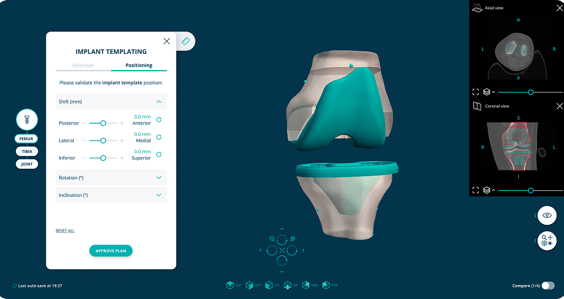
When planning is truly integrated, it doesn’t feel like a separate task. It feels like part of your decision-making process. You don’t “open a tool.” You refine your thinking. That’s a very different experience. Because the goal isn’t to add more to your day. It’s to make the decisions you’re already making… clearer. This is where platforms like PeekMed are evolving. Not by changing how surgery works. But by aligning with it. Supporting surgeons at the point where decisions are still open, before they become constraints. With:
- patient-specific visualization
- structured planning steps
- a clearer understanding of options before entering the OR
Planning becomes part of the workflow, not an interruption to it.
So what actually changes? Not the complexity of surgery. That remains. But the distribution of decisions shifts. More happens before the OR.
Less needs to happen during it. And that shift, quiet as it is, has a compounding effect. On consistency. On efficiency. On confidence.
You don’t need to rethink your workflow. You just need to understand where decisions are happening too late. Because when planning fits naturally into your process, it doesn’t slow you down. It changes how prepared you are when it matters most.
REFERENCES
- American Academy of Orthopaedic Surgeons. Clinical Practice Guidelines in Orthopaedic Surgery. 2022.
- Agency for Healthcare Research and Quality. Workflow and Patient Safety in Surgical Settings. 2021.
- Centers for Medicare & Medicaid Services. Value-Based Care Models. 2023.
- Gawande A. The Checklist Manifesto. 2010.
- Weiser TG et al. Surgical safety and workflow standardization. The Lancet. 2009.