Do You Need a Digital Twin in Orthopedic Surgery?
Preoperative planning has already changed how you operate. If you compare your current workflow to how cases were approached a decade ago, the difference is clear. You’re no longer relying solely on intraoperative judgment. You review imaging in detail. You define alignment strategies. You anticipate constraints before entering the OR.
That shift alone has improved consistency. But if you look closely, something remains. Even with planning, certain decisions are still made during surgery. And those decisions are where variability persists.
You start with a plan. But once the procedure begins, small uncertainties appear. You reassess alignment. You adjust positioning. You refine your approach based on what you see. This is not a flaw; it’s part of surgery. But it does introduce variability. Not because the plan was wrong. But because not every scenario was fully explored beforehand.
So the question becomes:
How far can planning actually go? (H2)
Preoperative planning brings structure. It reduces uncertainty. It improves consistency across cases. But it is still, in many cases, a static process. You define a strategy. You don’t always test it. And that creates a natural limit.
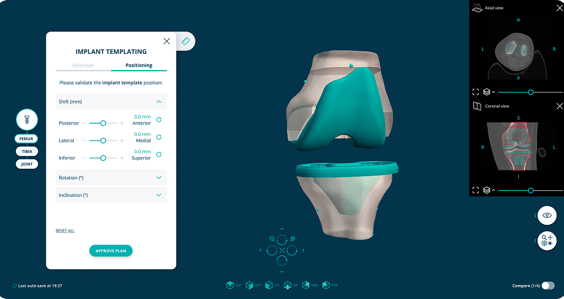
This is where simulation starts to make sense. Instead of defining a single approach, simulation allows you to explore multiple scenarios before surgery. Different implant positions. Different alignment strategies. Different outcomes based on small adjustments. Not theoretically, but in a patient-specific context. This is the idea behind digital twins.
Let’s be clear: this isn’t about hype. Digital twins are often presented as a futuristic concept. But at their core, they represent something simple: A more dynamic way to understand the patient before surgery.
A digital representation that allows you to:
- visualize anatomy in context
- test decisions
- anticipate consequences
Before stepping into the OR.
The best part? It builds on what you already do. This isn’t a replacement for planning. It’s an extension of it. If planning helps you define a strategy, simulation helps you validate it. And that distinction matters. Because the more decisions you can explore in advance, the fewer you need to make under pressure.
Where does this fit in today’s workflow?
Not every case requires this level of detail. And not every team is ready to adopt it fully. But the direction is clear. As expectations around consistency increase and as systems continue to prioritize predictability, tools that reduce uncertainty earlier in the process will become more relevant.
This is where platforms like PeekMed already play a role. By structuring planning, improving visualization, and supporting decision-making before surgery, they lay the foundation for more advanced approaches like simulation.
So, do you actually need a digital twin?
Not necessarily. At least, not for every case. But the underlying principle, reducing uncertainty before the OR, is becoming essential. And whether that’s achieved through better planning, improved visualization, or future simulation tools, the goal remains the same: make surgery more predictable.
You don’t need to simulate everything. But you do need to question how many decisions are still being made too late. Because the earlier clarity is created, the more consistent the outcome becomes.
REFERENCES
- American Academy of Orthopaedic Surgeons. Clinical Practice Guidelines. 2022.
- Centers for Medicare & Medicaid Services. Value-Based Programs. 2023.
- Agency for Healthcare Research and Quality. HCUP Data Overview. 2021.
- Porter ME. What is value in health care? N Engl J Med. 2010.
- Bozic KJ et al. Bundled payments in total joint arthroplasty. Clin Orthop Relat Res. 2014.