What Surgeons Notice After Adopting Preoperative Planning
You don’t change how you operate overnight. But something starts to feel different. Most surgeons don’t decide to change their workflow all at once. It usually starts small. A few cases where planning feels useful. Situations where uncertainty is slightly higher. Moments where you want more clarity before stepping into the OR. Nothing dramatic.Just a different way of approaching certain cases.
At first, it’s not about outcomes. It’s about control. Early on, the benefit isn’t always measurable. You’re not immediately thinking about alignment statistics or long-term results. What you notice first is something simpler. You feel more prepared. You’ve already explored sizing through alignment and visualized the anatomy. So when the procedure begins, you're not starting from zero.
The procedure feels… quieter. Not literally quieter. But cognitively. There’s less internal noise. Fewer moments where you need to pause and reassess. Fewer decisions that feel like they’re happening under pressure. When decisions are made earlier, they don’t carry the same weight in the OR.
Then something else starts to change. You adjust less. Not because cases are easier. But because fewer surprises show up. You’re not rethinking implant sizes mid-procedure. You’re not recalculating alignment on the spot. You’re following a path you’ve already defined. And consistency starts to emerge. Not perfectly. Not in every case. But enough to notice. Cases start to feel more similar, not because patients are the same, but because your process is. Consistency doesn’t come from doing the same surgery. It comes from starting the same way.
This is where the shift becomes real. Because at some point, planning stops being optional. Not by protocol. But by preference. You don’t reach for it only in complex cases anymore. You use it because it makes the entire process more predictable.
What changes isn’t just the plan. It’s the way you decide. Decisions feel earlier, clearer, and less reactive. And that changes the rhythm of the procedure. You’re not catching up with the case. You’re ahead of it.
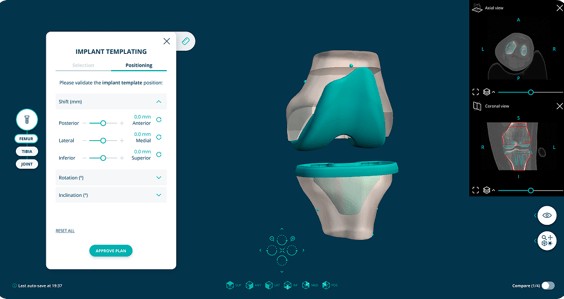
In orthopedic surgery, that difference matters more than it seems. Because small intraoperative adjustments add up. Over time, they introduce variability. And variability is what separates isolated success from consistent outcomes. This is where tools like PeekMed come into play. Not as an extra step. But as part of the process, helping you structure decisions before surgery, reduce uncertainty, and approach each case with a clearer plan. So execution becomes more about precision and less about adaptation.
You don’t notice it immediately. That’s the interesting part. The shift is gradual. Almost subtle. You don’t notice the difference… until you do. And when you do, it’s not about one case. It’s about how all cases start to feel different.
Adoption doesn’t happen when planning becomes available. It happens when not using it starts to feel like a disadvantage.
REFERENCES
- American Association of Hip and Knee Surgeons. Clinical Insights in Joint Replacement.
- American Academy of Orthopaedic Surgeons. Surgical Decision-Making Guidelines.
- National Institutes of Health. Decision-Making in Surgery.
- Kahneman D. Thinking, Fast and Slow. 2011.
- Gawande A. The Checklist Manifesto. 2009.